
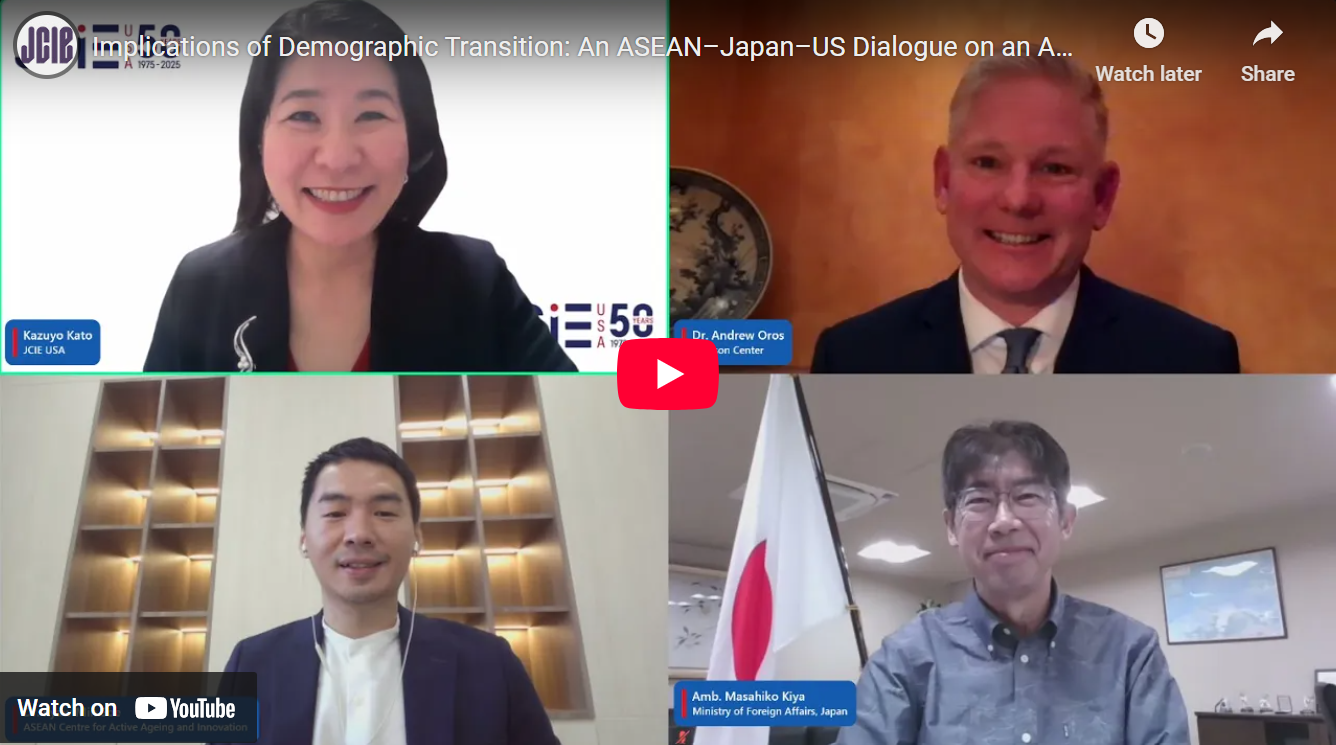
On December 17, 2025, the Japan Center for International Exchange (JCIE) hosted a pivotal webinar titled “Implications of Demographic Transition: An ASEAN-Japan-US Dialogue on Security, Innovation, and Regional Cooperation in an Aging Asia.” The dialogue convened leading voices, including former Japanese Ambassador to ASEAN Masahiko Kiya, Professor Andrew Oros (author of “Asia’s Aging Security”), and Dr. Kyaw Min Soe, Head of Policy Advocacy at the ASEAN Centre for Active Ageing and Innovation (ACAI), to explore how one of the century’s most profound shifts, rapid population ageing, reshapes regional security, innovation, and partnership.
In his remarks, Dr. Soe highlighted ASEAN’s established policy architecture for active ageing, anchored by the Kuala Lumpur Declaration (2020) and the ASEAN Strategic Framework on Health Development. He outlined ACAI’s role in translating these commitments into action through tools like the ASEAN Active Ageing Index (AAAI) and a concrete Regional Action Plan developed with Country Coordinators across member states.
He emphasised ACAI’s current proactive collaboration including city-level partnerships, such as Fukuoka-Rayong and ACAI’s innovation grants, which bridge public, private, and civil sectors to develop scalable solutions.
During the Q&A, Dr. Soe addressed the critical barriers to promote active ageing in the region by pointing out ASEAN’s diversity and the challenge of sustainable financing. He also reflected on Japan’s unique contribution to global public health, characterised by its focus on long-term partnership and institutional capacity building.
The session concluded with a forward-looking consensus: managing demographic transition requires more than policy, it demands deepened multilevel and cross countries cooperation to build resilient, inclusive societies for all ages.
Watch the full discussion here: https://youtu.be/ysZjRz3kDrA